

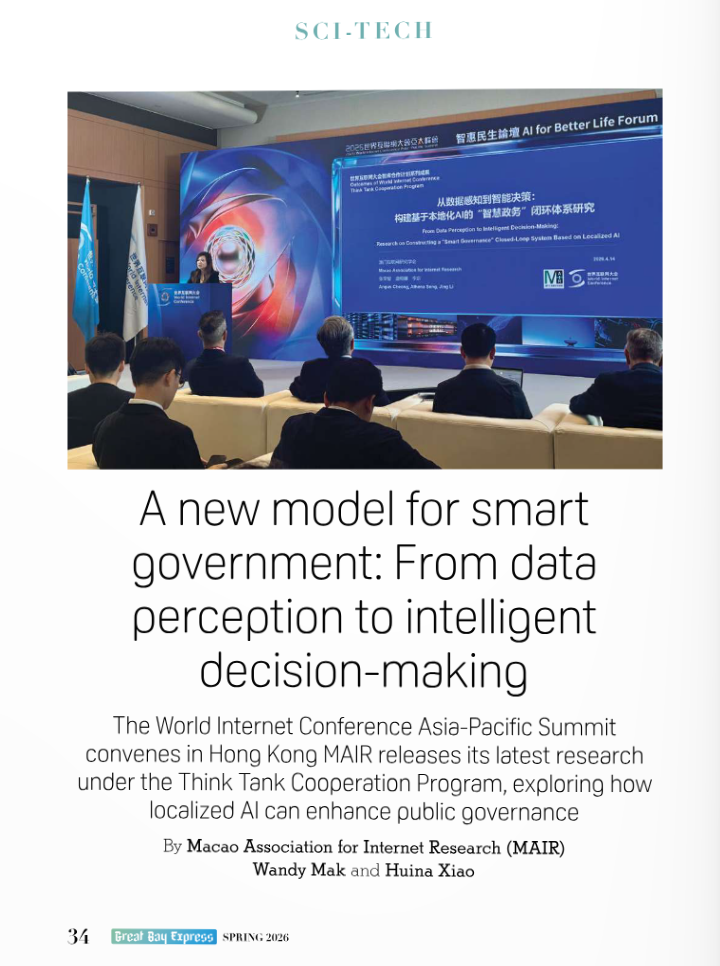
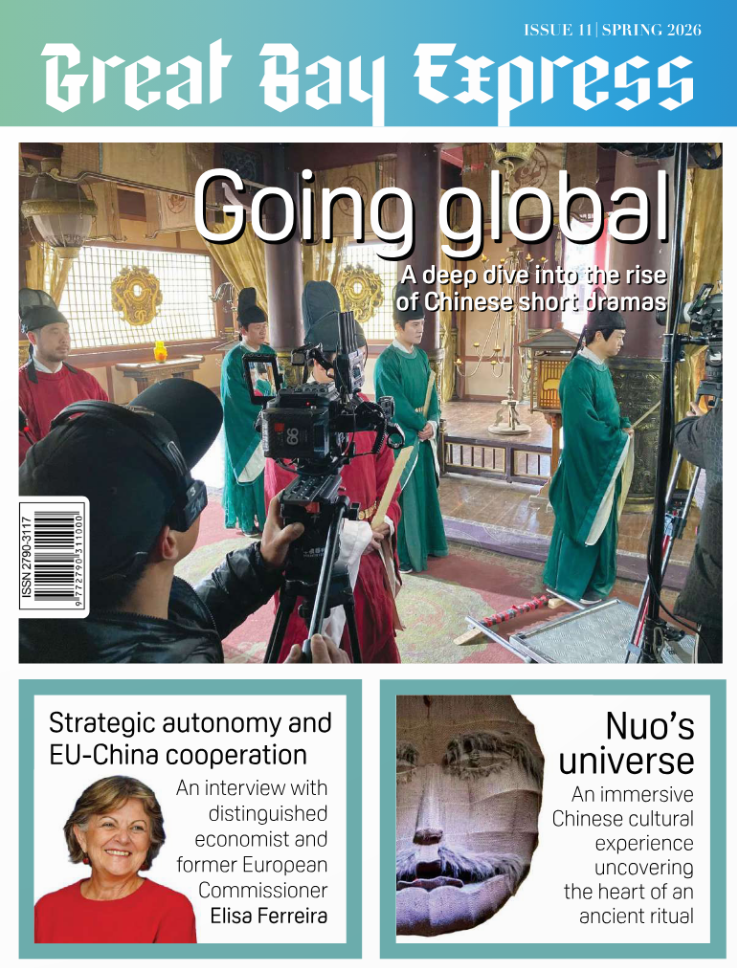
由亞太傳播交流協會(APCEA)出版及發行的英文刊物《大灣區快訊》(Great Bay Express)於2026年6月出版了第11期,其中發佈了《智慧政務新範式:從數據感知到智能決策》的文章。
2026年4月,香港會展中心舉辦第二屆「世界互聯網大會亞太峰會」,澳門互聯網研究學會理事長盛綺娜於「智惠民生」論壇上發佈學會的最新研究成果——《從數據感知到智能決策:構建基於本地化AI的「智慧政務」閉環體系研究》。該報告為世界互聯網大會智庫合作計劃系列研究成果,聚焦政府推進政務治理轉型過程中面臨的挑戰,並提出以「社交智能」為核心的智慧治理方法論,以推動「電子政務」向「智慧政務」升級。
盛綺娜表示,該解決方案可將洞察轉化為決策,幫助政府打造懂本地法規、懂本地民情的專屬AI大腦,讓AI應用的全流程變得更安全可控,且方案的價值不局限於澳門,只需要「換庫不換核」,替換為當地的語言與法律數據庫,就能快速複製。她期望該研究能為各地政府探索更貼近當地需求、可信可控的智慧政務模式提供參考。

關於《大灣區快訊》
《大灣區快訊》(Great Bay Express)是一個綜合性英文媒體,包括網站、雜誌及多個社交媒體賬戶。《大灣區快訊》秉承自由和專業的原則,為多元化報道粵港澳大灣區特別是橫琴粵澳深度合作區的最新發展提供了一個全新的平台。
《大灣區快訊》網站:
https://www.greatbayexpress.net

https://www.greatbayexpress.net/great-bay-express-11
以下為文章原文:
A New Model for Smart Government: From Data Perception to Intelligent Decision-Making
The World Internet Conference Asia-Pacific Summit convenes in Hong Kong
MAIR releases its latest research under the Think Tank Cooperation Program, exploring how localized AI can improve public governance
By Macao Association for Internet Research (MAIR)
Wandy Mak and Huina Xiao
In recent years, artificial intelligence has been moving rapidly into the public governance arena. Its use now ranges from organizing government information and analyzing public sentiment to responding to inquiries on public services. While these applications can improve administrative efficiency and strengthen government responsiveness, they also raise new challenges, including cultural and contextual gaps, data silos, data security, and accountability in decision-making. As AI becomes more deeply embedded in government workflows, the question of how to balance efficiency, local relevance, and safety has become central to the development of smart government.
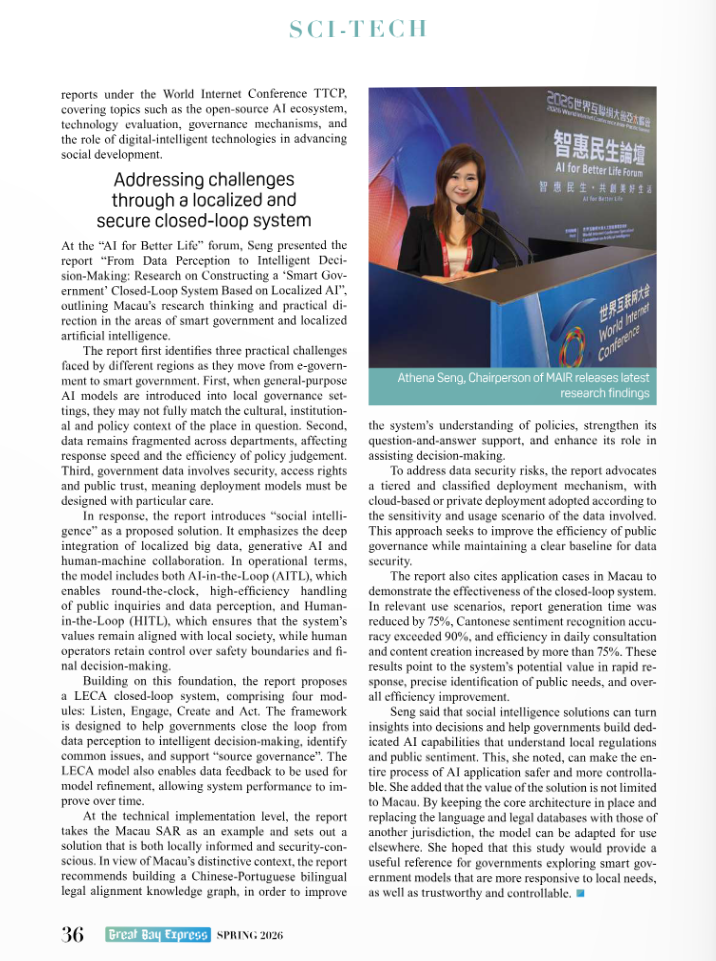
At the Second World Internet Conference Asia-Pacific Summit, held at the Hong Kong Convention and Exhibition Centre from 13 to 14 April 2026, Athena Seng, Chairperson of the Macao Association for Internet Research, released the Association’s latest study at the “AI for Better Life” forum. Entitled “From Data Perception to Intelligent Decision-Making: Research on Constructing a “Smart Government” Closed-Loop System Based on Localized AI”, the report is part of the World Internet Conference Think Tank Cooperation Program. It focuses on the challenges governments face in transforming public administration, and proposes a smart government methodology entered on “social intelligence”, with the aim of supporting the transition from e-government to smart government.
WIC Asia-Pacific Summit held in Hong Kong, with Macao think tank sharing research on smart government
The Second World Internet Conference Asia-Pacific Summit was hosted by the World Internet Conference, organized by the Government of the Hong Kong Special Administrative Region, and co-organized by bodies including the Innovation, Technology and Industry Bureau of the HKSAR Government.
Under the theme “Digital and Intelligent Empowerment for Innovative Development — Jointly Building a Community with a Shared Future in Cyberspace”, the summit brought together around 1,000 guests from more than 50 countries and regions. Participants included government officials, representatives of international organizations, senior executives from internet companies, and leading experts and scholars in the field of artificial intelligence.
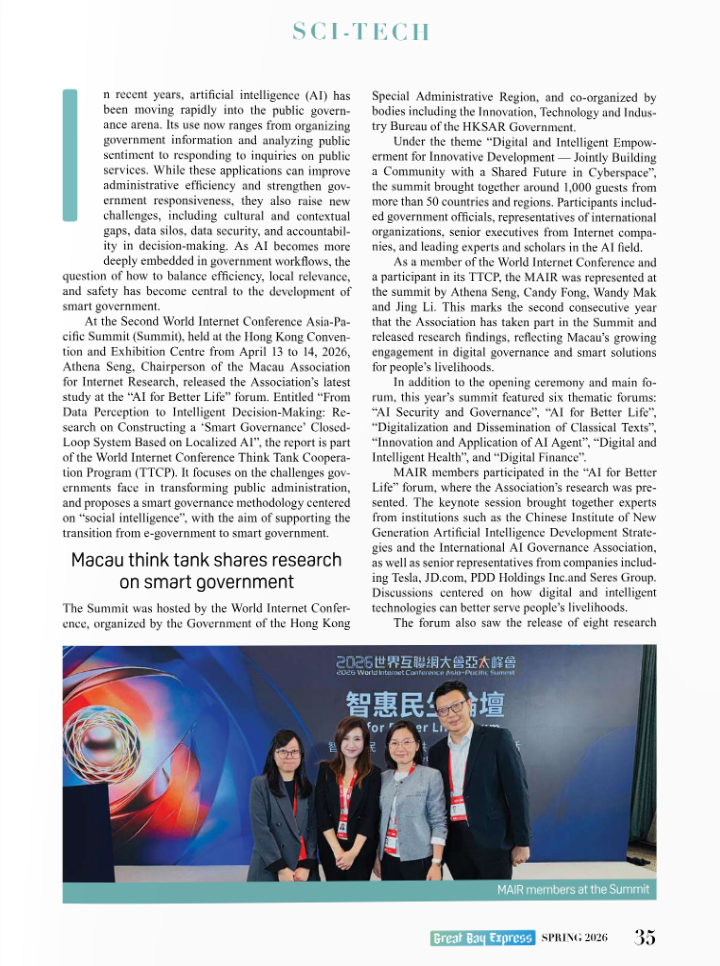
As a member of the World Internet Conference and a participant in its Think Tank Cooperation Program[1], the Macao Association for Internet Research was represented at the summit by Athena Seng, Candy Feng, Wanlei Mak and Jing Li. This marks the second consecutive year that the Association has taken part in the Asia-Pacific Summit and released research findings, reflecting Macao’s growing engagement in digital governance and smart solutions for people’s livelihoods.
In addition to the opening ceremony and main forum, this year’s summit featured six thematic forums: “AI Security and Governance”, “AI for Better Life”, “Digitalization and Dissemination of Classical Texts”, “Innovation and Application of AI Agent”, “Digital and Intelligent Health”, and “Digital Finance”.
Members of the Macao Association for Internet Research participated in the “AI for Better Life” forum, where the Association’s research was presented. The keynote session brought together experts from institutions such as the Chinese Institute for New Generation Artificial Intelligence Development Strategies and the International Association for AI Governance, as well as senior representatives from companies including Tesla, JD.com, Pinduoduo and Seres. Discussions centered on how digital and intelligent technologies can better serve people’s livelihoods.
The forum also saw the release of eight research reports under the World Internet Conference Think Tank Cooperation Program, covering topics such as the open-source AI ecosystem, technology evaluation, governance mechanisms, and the role of digital-intelligent technologies in advancing social development.
Addressing the pain points of smart government through a localized and secure closed-loop system
At the “AI for Better Life” forum, Athena Seng presented the report “From Data Perception to Intelligent Decision-Making: Research on Constructing a “Smart Government” Closed-Loop System Based on Localized AI”, outlining Macao’s research thinking and practical direction in the areas of smart government and localized artificial intelligence.
The report first identifies three practical challenges faced by different regions as they move from e-government to smart government. First, when general-purpose AI models are introduced into local governance settings, they may not fully match the cultural, institutional and policy context of the place in question. Second, data remains fragmented across departments, affecting response speed and the efficiency of policy judgement. Third, government data involves security, access rights and public trust, meaning deployment models must be designed with particular care.
In response, the report introduces “social intelligence” as a proposed solution. It emphasizes the deep integration of localized big data, generative AI and human-machine collaboration. In operational terms, the model includes both AI in the Loop (AITL), which enables round-the-clock, high-efficiency handling of public inquiries and data perception, and Human in the Loop (HITL), which ensures that the system’s values remain aligned with local society, while human operators retain control over safety boundaries and final decision-making.
Building on this foundation, the report proposes a LECA closed-loop system, comprising four modules: Listen, Engage, Create and Act. The framework is designed to help governments close the loop from data perception to intelligent decision-making, identify common issues, and support “source governance”. The LECA model also enables data feedback to be used for model refinement, allowing system performance to improve over time.
At the technical implementation level, the report takes the Macao Special Administrative Region as an example and sets out a solution that is both locally informed and security-conscious. In view of Macao’s distinctive context, the report recommends building a Chinese-Portuguese bilingual legal alignment, in order to improve the system’s understanding of policies, strengthen its question-and-answer support, and enhance its role in assisting decision-making.
To address data security risks, the report advocates a tiered and classified deployment mechanism, with cloud-based or private deployment adopted according to the sensitivity and usage scenario of the data involved. This approach seeks to improve the efficiency of public governance while maintaining a clear baseline for data security.
The report also cites application cases in Macao to demonstrate the effectiveness of the closed-loop system. In relevant use scenarios, report generation time was reduced by 75%, Cantonese sentiment recognition accuracy reached 89%, and efficiency in daily consultation and content creation increased by more than 75%. These results point to the system’s potential value in rapid response, precise identification of public needs, and overall efficiency improvement.
Athena Seng said that social intelligence solutions can turn insights into decisions and help governments build dedicated AI capabilities that understand local regulations and public sentiment. This, she noted, can make the entire process of AI application safer and more controllable. She added that the value of the solution is not limited to Macao. By keeping the core architecture in place and replacing the language and legal databases with those of another jurisdiction, the model can be adapted for use elsewhere. She expressed the hope that the study would provide a useful reference for governments exploring smart government models that are more responsive to local needs, as well as trustworthy and controllable.
[1] The World Internet Conference Think Tank Cooperation Program was launched during the 2024 World Internet Conference Wuzhen Summit. It is composed of 60 WIC member organizations and leading think tanks from around the world.
 繁體中文
繁體中文 简体中文
简体中文 English
 Português